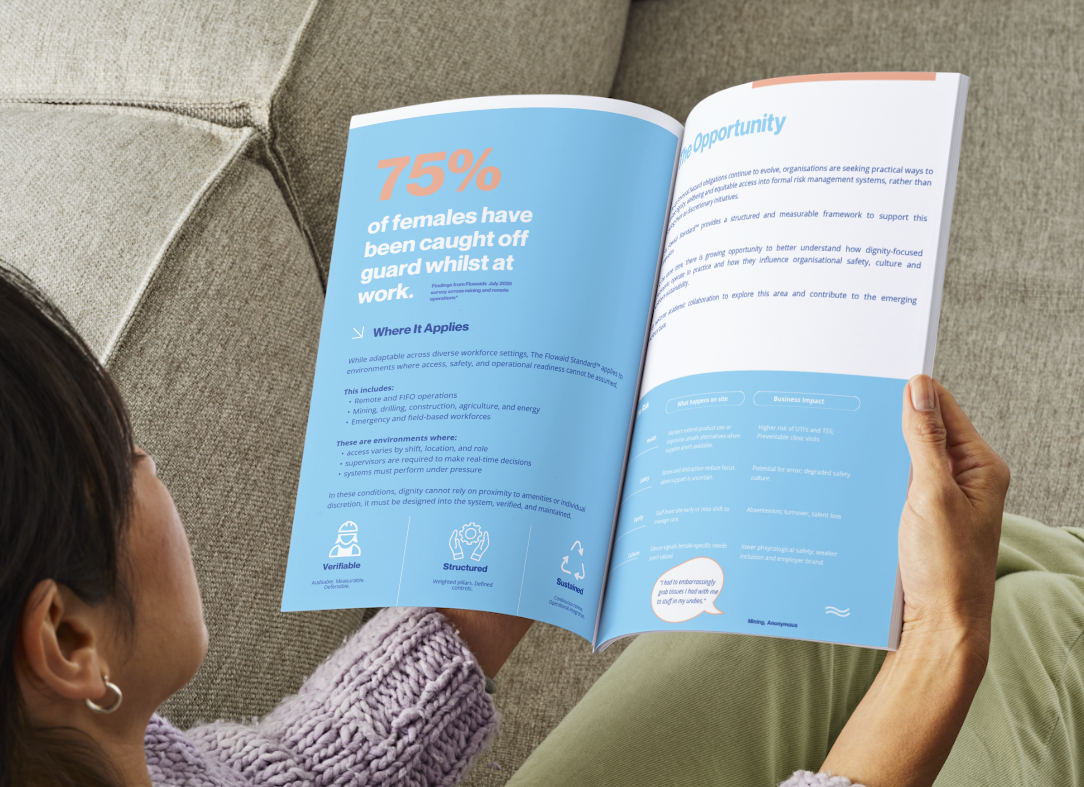
~ The Operational Benchmark for Workforce Dignity & Psychosocial Safety.
The Flowaid Standard™ defines the minimum operational requirements organisations must meet to achieve Certification for workplace dignity, hygiene access and psychosocial safety.
The Standard is outcomes-focused and systems-based, providing a clear benchmark for how organisations identify and address the needs, barriers and risks that can affect people at work.
It focuses on creating workplaces where people can manage essential personal needs safely, privately and without avoidable disadvantage - supporting dignity, confidence, psychosocial safety and wellbeing.
The Standard provides:
A clear benchmark for practice
Defined operational requirements
A structured approach to implementation
A pathway to evidence-based Certification

~ The Five Operational Pillars.
-
Ensuring workers can reliably access dignity and hygiene resources where and when they are needed across relevant operational environments.
-
Ensuring resources remain safe, fit-for-purpose, operationally suitable, and appropriately maintained.
-
Recognising dignity-related barriers, stigma, and unmanaged access issues as psychosocial hazards requiring formal control measures.
-
Creating trusted reporting pathways and using operational insights to strengthen systems over time.
-
Building workforce capability, leadership accountability, and respectful workplace expectations.
The Flowaid Standard™ is structured across five operational pillars.
~ What Alignment Looks Like.
Organisations aligned to The Flowaid Standard™ are able to demonstrate that:
Workers can reliably access dignity resources
Personal needs can be managed safely and privately
Dignity-related risks are identified and controlled
Systems are operational in practice
Workforce feedback informs improvement
Leadership accountability is clearly defined
~ Built to Be Applied.
Organisations aligned to The Flowaid Standard™ are able to demonstrate that:
Workers can reliably access dignity resources
Personal needs can be managed safely and privately
Dignity-related risks are identified and controlled
Systems are operational in practice
Workforce feedback informs improvement
Leadership accountability is clearly defined
~ Built Around Operational Reality.
The Flowaid Standard™ gives organisations a clear, practical framework they can apply to their own people, workplaces and operating conditions.
Because no two workplaces are the same, the Standard helps organisations understand their workforce needs, identify barriers and determine what effective practice looks like in their own environment.
But a Standard alone does not create change.
That is where our team comes in.
The Flowaid Standard provides the framework. We bring it to life through practical Implementation Workshops, accessible education and resources, ongoing support and a clear pathway to Certification.
Together, we give organisations the knowledge, tools and guidance to understand what is needed, identify where change is required and take meaningful action.
The journey is simple: understand the need, identify the gaps, act, embed the change and measure the difference.
Organisations do not need to have all the answers before they begin. The important first step is being willing to understand what their people need and improve how those needs are supported.
Turning the Standard into Action.
Turning the Standard into Action.
A practical pathway from understanding to action.
Implementation Workshops help organisations understand their workforce and operating environment, identify gaps and barriers, and develop practical actions that fit into existing systems and processes.
The approach is structured and collaborative, but not one-size-fits-all. We meet organisations where they are, including those addressing these issues for the first time.
The aim is not to add another initiative to manage. It is to help organisations make dignity, access and appropriate support part of how work is done.
~ Aligned to Expectations. Built for Familiar Practice.
The Flowaid Standard™ has been developed with recognised workplace health, safety and psychosocial expectations in mind, including:
ISO 45001
ISO 45003
Safe Work Australia’s Model Code of Practice: Managing the Work Environment and Facilities.
We have translated relevant expectations into a practical framework that helps organisations understand what effective practice looks like for the needs addressed by the Standard.
The Flowaid implementation pathway is designed around familiar workplace practices.
From understanding the workplace and identifying risks and barriers, to implementing controls, reviewing effectiveness and demonstrating evidence, the pathway uses approaches organisations already know through workplace health and safety management.
This is reflected across our Implementation Workshops, education and resources, and Certification process- including a self-assessment approach modelled on familiar WHS management practices.
The Standard provides the framework. The pathway provides a practical way to implement it.